

by Leta Young
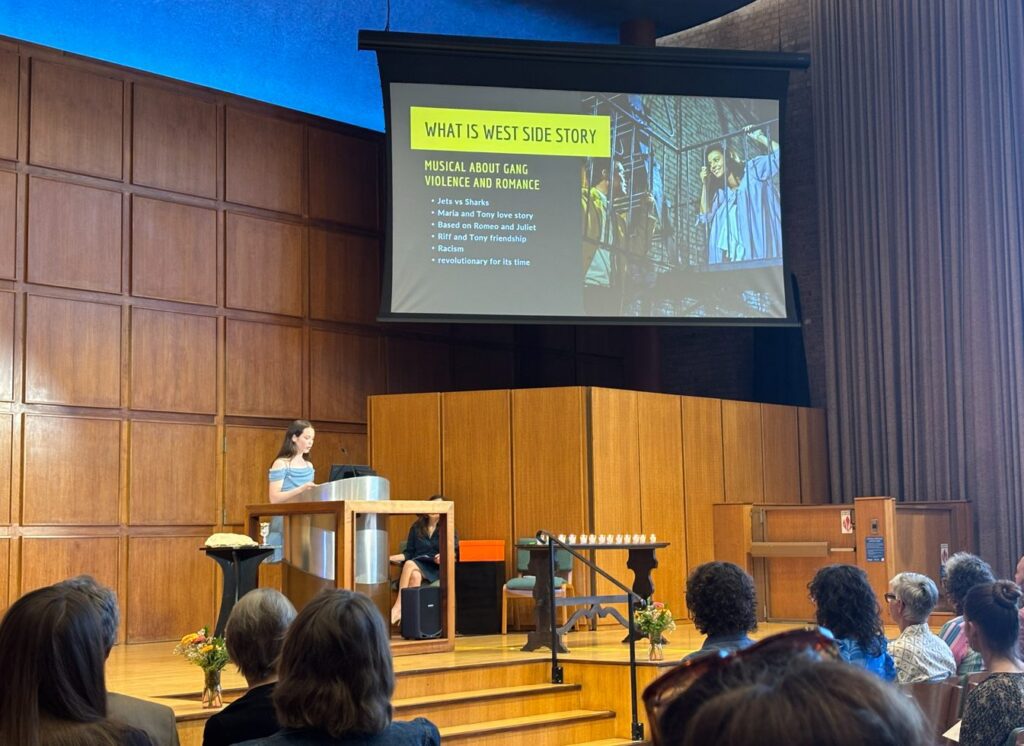
You’ve probably heard of the musical West Side Story about a boy named Tony falling in love with a girl named Maria. The one with the two rival gangs, the American Jets and the Puerto Rican Sharks; a modern retelling of Romeo and Juliet. I bet what you didn’t know is that West Side Story is Jewish! It was originally going to be called East Side Story, a musical about a Jewish girl falling in love with a Catholic boy. All four of the men who made it were Jewish. West Side Story was one of the most influential musicals of its time, even though it suffers from cultural appropriation. It also has some of the most interesting music theory but first let me tell you about East Side Story.
East Side Story would have been about a Jewish-Catholic love story taking place on the Lower East Side of Manhattan during the Passover-Easter time. It would have been about the experiences of the three original men that wrote it; Jerome Robbins the choreographer and director, Leonard Bernstein the composer, and Arthur Laurents the playwright.
The idea was created when Jerome Robbins’ lover needed help playing the part of Romeo; he asked Robbins for help and Robbins said to imagine it modernized. Robbins sat for a while with that idea until he eventually told Bernstein and Laurents his idea. They were all very excited about this idea and got to work immediately.
Eventually Laurents became disenchanted with the idea. He thought the Jewish-Catholic setup was tired. He felt that East Side Story was too similar to the hit play Abie’s Irish Rose, which was popular on Broadway in the 1920s. He told the others how he felt, and they decided to stop pursuing the idea because they would never replace Laurents.
To really learn about West Side Story, you have to learn about the creators. Originally it was just Laurents, Robbins, and Bernstein. Bernstein realized he didn’t have enough time to compose the music and write the lyrics, so he hired a young Steven Sondheim. West Side Story is about their experiences trying to be considered “real Americans.” It was personal for them. They felt they knew discrimination because of their ethnoreligious background and sexuality. All four of these men were Jewish at a time when Jewish people faced strong discrimination in this country. And they were gay in a time when it was a crime. Most of the themes of the musical have personal meaning, like the fragility of love.
Bernstein composed two symphonies by 30; he led a major American symphony orchestra and was the first American to conduct at La Scala. Not only was he an expert musician and composer, but he fought for civil rights and wrote West Side Story as a plea of tolerance. He was born into a Russian-Jewish immigrant family and named Louis Bernstein. The song “One Hand, One Heart” from West Side Story represents him as a gay man. He was married to a woman and, just like Maria and Tony, he could only dream of marrying his love.
Steven Sondheim was by far the youngest of the four. West Side Story was his first Broadway musical. He was hired to be the co-lyricist with Bernstein, but Bernstein let him take all the credit to launch his career. Sondheim in his later years worked on the 2021 Steven Spielberg movie version of West Side Story. He changed the lyrics to make them feel more real and less problematic. His first and last project was West Side Story.
Jerome Robbins was the choreographer and director of West Side Story. He may have been the musical’s most influential voice. When he was getting started in his career, Jerome Robbins changed his name from Robinowitz to Robbins so his name would sound less Jewish. He was very secretive about his Jewish identity. He thought that if he wasn’t Jewish he would get more opportunities. He was a demanding director. The actors in the original Broadway show called him “Big Daddy” for his big energy and commanding voice. His vision for West Side Story was to have the story portrayed through dance, because he was a ballet choreographer. Later in life he made West Side Story into a ballet.
The last member of the team was Arthur Laurents, also Jewish and gay. Out of the four men he was the most openly gay. Before he wrote West Side Story he wrote the play Home of the Brave, about a Jewish soldier returning from the war and facing discrimination at home. Laurents wrote a subtextual gay romance into this play. Later this play was turned into a movie where instead of Jewish the soldier is black. Laurents also worked to update West Side Story during its revival in 2009, adding more Spanish to make it feel more realistic.
West Side Story began when Laurents and Bernstein met in 1955 to talk about East Side Story. They had a long conversation about the musical they had put away. They then started to talk about gang violence, and the idea was born.
The making of the show was extensive; they wanted it to feel as real as possible. They even got someone to go to a school dance on the West Side and take notes. Robbins made all the actors use method acting. He didn’t allow the Jets to talk to the Sharks. They even had separate rehearsals. At the time it was unacceptable to swear on stage, so Laurents created fake slang for them. They said stuff like “cut the jibber jabber,” or “mother-loving street.” Robbins had very demanding ideas for the show. Bernstein would write something and play it on the piano. Robbins stood behind him, his hands on Bernstein’s shoulders, listening, then tell him to write it again.
The musical was ahead of its time. Most musicals were meant to be happy and fun, so West Side Story’s dark themes contrasted with that. West Side Story ended sadly and used dance to move the plot. Because it was so unique, many producers turned it down.
People thought West Side Story wouldn’t be popular, but it opened in 1957, ran for 732 shows and was nominated for six Tonys.
Bernstein wrote beautiful music for West Side Story, but the notes tell a story, even without lyrics. The first three notes of the show are the backbone of the show, mimicking a shofar call. Those three notes are called a tritone, better known as a devil’s chord. They are used heavily throughout the show. The shofar call in the beginning is known as the “hate motif” in the show. It plays during fights or tense scenes. The other motifs are the “Jets motif” the “Maria motif” and the “something’s coming” motif. The hate motif and Jets motif are unresolved tritones, so they sound tough, intimidating, or unsettling. The something’s coming motif is slightly more resolved, but not quite. It seems to ask a question. Finally, when Tony sings “Maria” the tritone is resolved. It answers the question of something coming and resolves the hate and Jets motif, showing that love beats hate.
Something interesting about the music of the show is when Tony’s best friend Riff talks about Tony, we hear the Jets motif, because Riff is sure that Tony is still a Jet. Then when we see Tony for the first time there is no Jets motif, because he is unsure if he’s still a Jet. Finally, when Tony says yes to going to the dance with the Jets we hear the Jets motif, because he is a part of the group again.
The tritones are used to express the main conflict and to set the tone of a scene. The song “America” has no tritones, because it’s not a part of the main conflict.
At the time West Side Story was made it was a crime to be gay. Gay people faced severe discrimination and hardship. A lot of LGBTQ+ people were closeted or very secretive, lest they be blackmailed or targeted. Leonard Bernstein was targeted by the FBI for his liberal beliefs, but pulled through. Jerome Robbins was blackmailed by the House Un-American Activities Committee. They told him that if he didn’t rat out his communist friends, they would tell the world he was gay. He ratted out his friends and regretted it the rest of his life.
In the 50’s Puerto Rico had a substantial Jewish community. It has the richest and wealthiest Jewish community in the Caribbean.
After World War II, New York was changing. Jews moved out of the Lower East Side and other immigrants replaced them.
West Side Story was the perfect mix of comfort and taboo. At the time a mixed-race couple was taboo, so that made the storyline attention-grabbing. But if they made West Side Story a gay romance, it would have been taboo, and people wouldn’t have come to see it. The writers were also trying to tap into the concerns of the time, immigrants in New York, and fears of gang violence.
The musical addressed racism and prejudice—and was unique for its time. It had more song, dance, and music than spoken lines, it was sad, and it didn’t have a happy ending. West Side Story was also the first musical to have an authentic Hispanic sound.
According to the famous Puerto Rican playwright and lyricist Lin Manuel Miranda, West Side Story was both a gift and a curse to the LatinX community. It gave LatinX performers an opening in theater, but it also overshadowed real LatinX theater. Rita Moreno, who played Anita in the 1961 movie version of West Side Story, was the first Latina to win an Oscar. West Side Story was so popular that when it came out on vinyl it spent 54 weeks as the top album.
Another influential part of West Side Story is the song “Somewhere.” I used to think that song was called “There’s a Place for Us” because that phrase is repeated throughout the song. That song has themes related to the creators’ homosexuality with the lyrics painting a picture of how somewhere there will be a place where it’s safe to love each other. The song was very meaningful to the gay community during that time.
West Side Story is a beautiful and important musical, but it has some controversy around it. It’s a musical about the Puerto Rican experience but all the writers were white. They wrote from their experiences being Jewish immigrants assuming that all immigrants had the same experiences. They were wrong about this, so the Puerto Rican experience in this musical is inaccurate. In the original version of the song “America,” the characters make fun of Puerto Rico, offending some people who love the place that they come from. When Steven Sondheim rewrote the lyrics for the 2021 movie, he changed the lyrics to show that the characters liked both America and Puerto Rico.
The other problem with West Side Story is that some of the actors that played the Puerto Rican characters were white. In the 1961 movie version, both Maria and Bernardo were white and used brown paint to make their skin look darker.
Another problem was that West Side Story overshadowed real Puerto Rican theater, and the experiences of real Puerto Ricans. People point out that Jets is an all-American, tough, powerful-sounding name, and Sharks sound dangerous.
I hope you’ll have a deeper understanding of what I consider to be, in spite of some controversy, one of the best Broadway musicals. Created by four gay Jewish men, who drew on their personal experiences and unique talents, West Side Story made history. Its soundtrack rose to the top of the charts and inspired many. It is a very beautiful musical with powerful themes. I hope it inspires you just as it has inspired me.
Read More from The IlluminatorDid you know? Or Emet offers both youth and adult B Mitzvah programs!