Life Cycle Ceremonies
Or Emet offers the full range of life cycle ceremonies—baby namings, b mitzvahs, weddings, and funerals. Rabbi Eva Cohen works closely with individuals, couples, and families to craft personalized ceremonies that celebrate the people who are the focus. These ceremonies run the gamut from highly eclectic to more traditional. They feature Humanistic adaptations of Jewish ritual and may also incorporate elements from other cultural traditions, honoring your diverse, intersectional identities.
Curious to learn more about Humanistic Jewish life cycle ceremonies? The following summaries may be helpful:
Baby Namings
The baby naming ceremony warmly welcomes a new baby into your family. It is a gender-neutral, secular alternative to the bris/brit milah (the religious Jewish ritual of male infant circumcision, which Humanistic Judaism does not require). Honoring both Jewish and humanistic values, it celebrates the promise of this new life and the intergenerational passing on of traditions. Typically, parents meet with Rabbi Eva Cohen to discuss and shape the ceremony. Parents, grandparents, siblings, and other important family members and friends can all play important roles. Every baby naming is unique.
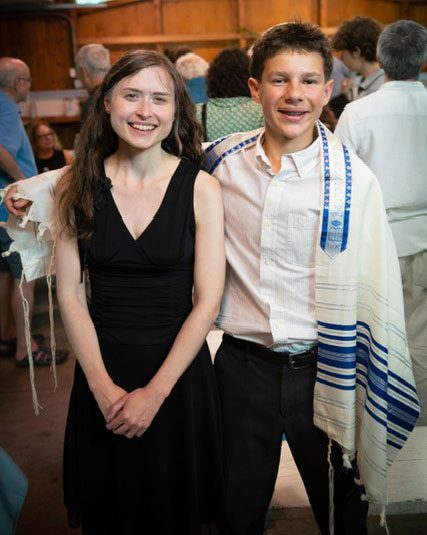
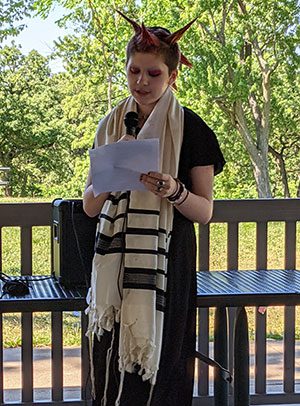
B Mitzvahs
These celebrations mark an important step toward adulthood. The term “b mitzvah” includes bar mitzvah, bat mitzvah, and young adults of all genders who do not identify with the “bar” or “bat” label.
Rabbi Eva Cohen leads Or Emet’s B Mitzvah Program. In the year leading up to their b mitzvah ceremonies, youth study as a group with Rabbi Eva while choosing and taking part in Jewish cultural, service, and tikkun olam activities. They also study individually under Rabbi Eva’s guidance, exploring a Jewish topic of personal interest through a humanistic lens. Presenting their individual learning is the b mitzvah ceremony focus. Topics range widely—from Jews in sports to Jewish women partisans, from family history to Jewish calendar mathematics to Marc Chagall’s art. Young adults’ unique talents and perspectives also shine through in their creative presentation approaches. B mitzvah youth have created and presented original paintings, documentary and animated films, graphic novels, and plays as well as given speeches. Along with this presentation, they also deliver a short Humanistic Torah commentary and may or may not chant part of their Torah or Haftarah portions. Ceremonies honor the larger family and community along with the young adult. Or Emet b mitzvah ceremonies are typically scheduled in the summer to facilitate family and community involvement.
Youth must study in Or Emet’s Jewish Cultural Sunday School (JCSS) for at least one year before participating in the B Mitzvah Program. Or Emet b mitzvah ceremonies typically occur over the summer, after the school year ends. This means that a youth who would like to become a b mitzvah at age 13, over the summer after 7th grade, should enroll in the JCSS at the beginning of 6th grade at the latest.
For more information on adult b mitzvah preparation and ceremonies, visit our Adult Education page.
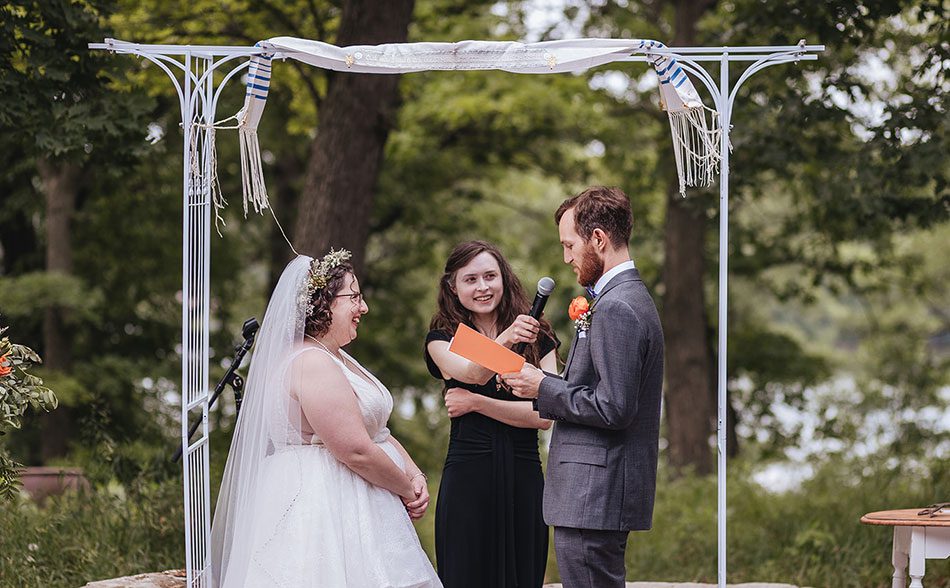
Weddings
Rabbi Eva Cohen works closely with couples to craft their dream ceremonies. Your wedding ceremony may or may not include a chuppah, a ketubah, breaking the glass, or Humanistic versions of other Jewish wedding traditions that hold meaning for you. It can incorporate your favorite songs and movie quotes. It can feature interfaith and intercultural elements, and it can include a co-officiant representing another faith or cultural tradition. As a part of the ceremony, Rabbi Eva’s “comments on the couple” give your guests insight into your unique love story.
Or Emet and the larger Humanistic Jewish movement honor loving relationships in many forms. We celebrate and affirm LGBTQ+ relationships, interfaith, “interfaithless,” and intercultural relationships, as well as polyamorous and other consensually non-monogamous relationships.
Funerals and Memorials
On the sad occasion of an Or Emet member’s passing, Rabbi Eva Cohen consults with the family and together they plan a meaningful celebration of the family member’s contributions and legacy. We believe that people’s potential to positively influence the world carries on in all of the people whose lives they touched. Typically, several people speak, instead of a single featured eulogy, underlining that this is both a family’s and a community’s loss. One way we honor Jewish tradition is by including a Humanistic adaptation of the Mourner’s Kaddish.
Becoming Jewish – Adopting Jewish Identity
Humanistic Judaism affirms “that a Jew is a person of Jewish descent or any person who declares [themself] to be a Jew and who identifies with the history, ethical values, culture, civilization, community, and fate of the Jewish people.” If you identify as Jewish, you are Jewish—no need to “prove” your Jewishness or to convert. Because we see Jewish identity in cultural and relational terms, we talk about becoming Jewish as “adoption,” not “conversion”; you are adopting Jewish identity and being adopted into the Jewish community.
Adopting Jewish identity can be a simple matter of self-declaration and self-identification, or it can involve a formal process. If this process feels meaningful to you, Rabbi Eva Cohen can work with you to develop a personalized study program that culminates in an adoption ceremony. This ceremony can include a Humanistic beit din and/or mikveh (ritual bath) immersion if you find these rituals personally meaningful, or you and Rabbi Eva can co-create another kind of ceremony that celebrates your adoption.
Anyone who would like to celebrate Jewish culture humanistically is welcome at Or Emet! There is no need to identify as Jewish or to be considering adopting a Jewish identity to participate in our services and programs or to become a member.