
B Mitzvah Presentation by Rose King

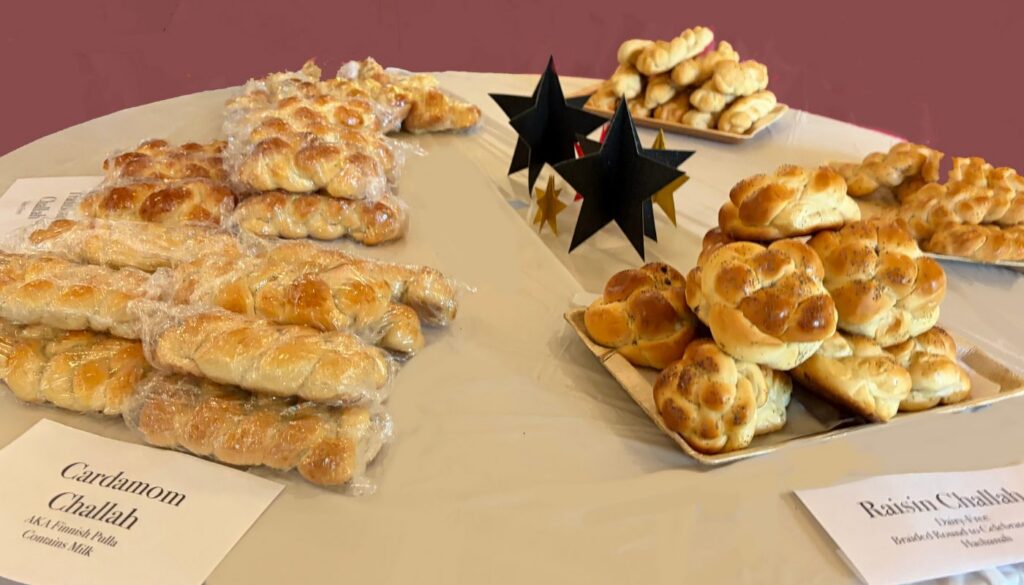
Challah is a braided bread commonly served on Shabbat and other Jewish holidays. It is traditionally slightly sweet, egg-rich, and baked kosher.
Challah first appears in the Torah in Leviticus 24:5 when God tells the Israelites to bake twelve loaves of bread as part of an offering. In Numbers 15:18-21, God tells Moses to set aside a bit of bread dough as an offering to the priests. In Hebrew, this translates to challah.
The first mention of the challah we know is in a book written around 1488 in Austria, where the name is first used for the bread itself. But braided bread is very old. Ancient Greeks and Romans baked braided bread for festivals. In Austria, Germany, and Poland, pretzel-like breads were traditional during Lent.
Challah wasn’t always braided. That didn’t start until around the 15th century in Austria and Germany, where Jewish housewives picked it up from their non-Jewish neighbors, who would bake similar braided bread on Sunday. Over time, the braided bread became associated with Jewish traditions and the Sabbath.
The symbolism of challah has changed over time and in different places. The oldest challah was likely round and was said to resemble the manna that God gave the Israelites in the desert. Shabbat and holiday breads were likely always different from regular weekday breads. Now we bake round challah for Rosh Hashanah to symbolize continuity.
Braided challah may also have different meanings. In some places, the braided shape may have reminded people that it was most likely prepared alongside meat dishes, and to not eat it with milk, as forbidden by laws about keeping kosher. In modern times, the strands may represent love, truth, peace, creation, freedom, harmony, family connection, unity and justice.
Over time, Jews in different countries developed their own variations on challah. In Ukraine, some Jews made challah in twelve parts, like the twelve loaves from Leviticus. In parts of Germany, some Jews ate braided bread at the end of Shabbat, because it looks like a braided Havdalah candle. And elsewhere in Germany, some challah had knife holes in it, and the challah that wealthy Jews ate was full of spices.
Dobre Dobre: Baking from Poland and Beyond is a cookbook written by Laurel Kratochvila that focuses on Polish and Jewish heritage baking. She writes:
“I wound up skidding around snow drifts to cross the border into Poland, the first time anyone in my family had been back in about a hundred years… We sloshed across the street and into the warm, yeasty bakery, and everything hidden behind the foggy window came into view: an almost impossible variety of cakes, danishes, and buns… Against the wall were loaves of rye bread, fluffy white rolls, and – what was that?
“Is that challah?” I asked.
“Chalka.”
“Yes! Challah!”
“Nie. Chalka.”
This lady clearly didn’t know what she was talking about. A neat stack of glossy golden braids sat on the shelf. Challah. I’d know it anywhere.
While an exact number isn’t known, some speculate that until the Second World War, up to half of Poland’s bakers were Jews. There was almost no city or town without at least one Jewish bakery and it wasn’t unusual if half or even all of the bakeries were Jewish. This disproportionate representation… was a result of the historical ghettoization of Jews into limited professions. But all that changed in the war… Jewish bakers basically don’t exist in today’s Poland.”
This made me think about the impact Jews had on Poland and how our mark is still there today. Even though the Holocaust decimated and drove away most Jews, our traditions still stuck, just under different identities.
Challah isn’t just used inside the Jewish community! It is used in baking too—french toast, bread pudding, and breadcrumbs! There’s also a lot of non-culturally significant challah variations such as cinnamon, olive, and chocolate, or my personal favorite, cardamom. However, some people don’t do a very good job at representing the Jewish culture ingrained in this tradition.
In a clip from the Great British Bakeoff show (season 5, episode 2), Paul Hollywood and Mary Berry try “plaited bread.” They make no mention of challah, which is pretty obviously what they are eating. Mary says, “This is a great thing to make for a sort of festive occasion.”
Yes Mary, it is, because millions of Jews make it every Friday for Shabbat.
Paul says, “[braiding bread] is a skill which is dying off”.
No Paul, because yet again, millions of Jews make it every Friday for Shabbat.
In Paul Hollywood’s cookbook, he has a page on challah—spelled cholla. Here he has butchered an attempt at representing Jewish culture. Further down on the page, he says that challah is, “traditionally served on Passover.”
Y’know, the holiday where challah is EXPLICITLY BANNED?
Writing about the history of challah in the journal Modern Judaism, an independent scholar wrote, “[A]dopting culinary practices such as braided bread from their neighbors was not seen as problematic… It was simply that Jews were exposed to the cultural norm of braided bread as a signifier of a festive meal and incorporated it into their holidays as well… In this way, challah joins a long list of foods considered ‘traditional’ by Jews but which historically are remnants of contact with the surrounding communities in generations past.”
Challah first appears in verses in the Torah telling Jews to make an offering of bread to priests. But once there were no priests to receive the offering, the meaning of challah changed. And when Jews learned from their neighbors that braided bread is festive, challah became braided bread. Even in Poland, Challah remains part of bakery culture.
What we learn from the story of challah is that Jews revise our traditions over time, changing circumstances, moving to new places, learning from our neighbors, and teaching the next generation. As my aunt said when helping me with this presentation, every time a Jewish family bakes challah, we leave our fingerprints on this tradition.
Read More from The IlluminatorDid you know? Or Emet offers both youth and adult B Mitzvah programs!