

B Mitzvah Presentation by Ilana Binder
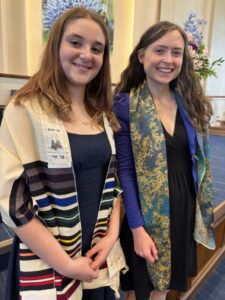 When I learned what a bat mitzvah was, I didn’t question what it meant or why we were doing it until I started to hear about some of the traditions I would and wouldn’t be participating in. When I learned of the project and the Torah portion, I wondered why we weren’t doing it the way other people in my school and family did it, and I couldn’t help but ask questions. This project was inspired by my curiosity about the large milestone and tradition that I was going to get to experience.
I studied the history and meaning of the bar, bat, and b mitzvah, consulting many articles and sources, but the most helpful and meaningful were what my family and friends said about their experiences.
First, some history. Though Judaism has been around for millennia, the bar mitzvah has not. Before the bar mitzvah ceremony was even a thing, the Mishnah and the Talmud clearly stated that a father must teach his son how to perform many commandments by a certain age. The father is supposed to teach his son by the time he is ready to be an adult—at first the age was 20, then later 13. What I’ve gathered is that the bar mitzvah was most likely created to mark a set age for a boy’s father to successfully train his son.
Historians believe that the bar mitzvah ceremony came into being sometime after late antiquity and the early medieval period. Starting around the thirteenth century CE, the first known bar mitzvahs were celebrated in Germany and France.
The bar mitzvah became the more formal tradition we know today around the sixteenth century and has been part of Jewish tradition in many ways throughout the last several hundred years. The bar mitzvah is now understood and regarded by many Jews as being more about the sentiment and understanding of a boy becoming a man than a boy finally being obligated to perform new commitments.
The bat mitzvah started hundreds of years later than the bar mitzvah. Though there was a sort of Jewish coming of age ritual for a group of girls in Berlin, Germany in 1817, the first individual female coming of age ceremonies were in 1844 in Italy. The first known bat mitzvah in America took place on March 18, 1922, right after women gained the right to vote. In the late 1940s some Conservative Jewish congregations started doing the same, though it wasn’t until around the 1970s that the practice became widespread in Conservative and Reform synagogues. Many Modern Orthodox congregations also now celebrate the bat mitzvah at the age of twelve.
What I think is wrong and reflects badly on how we have treated women over the years is that the bat mitzvah, which should have been a birthright from the start, came into common practice in the late 1900s. This was barely before the introduction of a whole new branch of Judaism—Humanistic Judaism. The Humanistic b mitzvah was created at about the same time as Humanistic Judaism itself, in the early 1960s. The b mitzvah came to Minnesota in the early 1990s at Or Emet (that’s us!), which is the official Humanistic Jewish congregation of Minnesota. I get to follow in that tradition.
One thing I learned from interviewing others is that there isn’t one set meaning to the bar, bat, and b mitzvah, or really to Judaism itself. To be honest, when I started the process, I didn’t really think of my own answers to some of the questions I asked other people. Later on, I started to think about the fact that my Humanistic approach would be quite different from some of the more religious people I was interviewing. When I asked what people thought the bat, bar, and b mitzvah was about, it seemed like they assumed that their answer was like everyone else’s, but really almost none of the responses I got were even similar.
During my research and interview process I got to read and hear about a lot of different ideas about the b mitzvah. My original assumption was that the ceremony was an ancient tradition that everyone participated in. But getting to hear what my friends and family experienced made me think more about why we do it and not just how we do it. A lot of people said if given the choice to go back they would still have one–even some of the people who didn’t have one. I thought that was interesting because, even with all their different backgrounds and circumstances, they all have an understanding of the importance of tradition and its connection to their Jewish culture and semi-recent history.
When I asked about people’s experiences of when they had their b mitzvah the younger people talked about the literal event and how it was a fun experience and that they felt more grown up. The older people talked how they didn’t recall much of the logistics but remember that it was a great learning experience that helped them navigate and go through life.
Some of the younger people talked about how it didn’t change much in their life or personality. The older people talked about how later on they cherished the experience. These different views could be seen as maybe a change over generations but I think that when the experience is fresh and you’ve been thinking and planning for it, once it actually occurs it’s more about it finally happening than a life changing event or learning experience. It hasn’t had time to sink in. People think of it more as a chance for learning later on because they’ve had more big life experiences and life changing events to appreciate the practice and how meaningful it actually was.
The group of people I interviewed didn’t have much ethnic diversity but across the Jewish tradition there’s a lot. One of the most interesting parts of learning about my Jewish history and Jewish history itself is that most Jews do actually derive from the area we know today as Israel/Palestine but have migrated all over the world. My family is from around where the Russian Pale of Settlement used to be.
Even though Jews are a smaller group of people, there are still millions of us all around the world. Like a lot of my interviewees said, you could have nothing else in common with someone you meet or go somewhere in the world completely different and when you find somebody Jewish it’s like an automatic connection. I’ve always thought of being Jewish as like a string connecting people from all over the world and it’s so cool to think that people my age across the world could be experiencing the same thing that we’re doing today.
When I asked people what being Jewish meant to them, they said completely different things.
Some people talked about tradition and the memory of what we’ve always practiced. Others talked about a connection to others around the world or to their ancestors. For some it was about an identity and it being a way of life. Still others talked about remembering our ancestors’ past and the hardships they went through and we still go through and why we celebrate them. A lot of people I interviewed were agnostic or not very practicing but others were. What I thought was really interesting about that is though they had different experiences and views, all together their answers could be knit together into a greater meaning.
In my opinion, being Jewish isn’t just about the religious aspect but it’s also about our culture and how we were raised. I was raised in a community where I always thought being Jewish was more of an ethnicity and culture than a religious identity. I didn’t learn about the religious aspect until I was older.
In my opinion, in the past, Judaism was more about everyone following the same rules and believing the exact same things and, to some people, it still is. Now I understand it more as our shared history and stories and traditions being passed down whether you believe them or not. Some may think that being a Humanistic Jew doesn’t count at all but it’s just the decision to keep tradition and family without devoting our lives to God. My dad’s side of the family is all different branches of Judaism and varying in religiousness but we still come together once a year on Thanksgiving as one.
I love the fact that my immediate family can be humanistic and have our own beliefs while some of my friends or extended family can be religious and live their lives as they please but we can still be a community together.
Read More from The IlluminatorDid you know? Or Emet offers both youth and adult B Mitzvah programs!